Sunday, November 8, 2015

Moon Over Buffalo Set Design

For many years, I have been the staff photographer at the Bellingham Theatre Guild. My photos regularly appear in the local papers. I have also had the opportunity to act in a few of the BTG productions.

Lately, I have also been getting re-involved in more of the actual productions at several of the local theater companies. (I've finally confided to several local directors that I am an architect by profession and have "some" past experience in set design.) Last year, I designed the sets for "The Sound of Music" at the Claire VG Thomas theater in nearby Lynden, WA.

Most recently, I designed the set for "Moon Over Buffalo", also at the Claire VG Thomas. This was a relatively straight-forward design endeavor. "Moon Over Buffalo" is what is known as a five door farce, meaning the stage direction clearly calls for five separate doors, and much of the action involves actors entering and leaving through these various doors. Almost all of the play takes place in the green room at the Erlanger Theatre in Buffalo, NY. "Moon Over Buffalo" was written by Ken Ludwig and originally starred Carol Burnett and Philip Bosco. It premiered on Broadway at the Martin Beck Theatre on October 1, 1995.

The Claire VG production was directed by my good friend and director extraordinaire Teri Grimes and costumed by my amazing wife Genny.


Since I often search in vain on the web for set ideas, I decided to start sharing my designs so that others might be able to use them as a springboard when developing their own concepts. Of course, each stage is different and will have its own particular challenges. For example, the Claire VG stage is quite small, measuring just 27-feet across at the proscenium and just over 17-feet deep. It also has just a 3-foot wing stage right, although the wing at stage left (which doubles as a shop area during set construction) is more than 20-feet by 20-feet. There is also no way for actors to cross between the wings unless the designer steals some depth and builds a false wall across the rear of the stage. One nice aspect of the Claire VG stage, however, is its 14-foot height to the teasers, but there is very limited fly space above that height.

For "The Sound of Music", which had more than 25 scene changes, I designed everything on wagons that could be quickly rolled on and off stage. For "Moon Over Buffalo", nothing had to move, so I was able to build the set walls to the full 14-foot height.


All of the set design/construction drawings were done in 3D using AutoCAD 2016. I like to be able to show the director a three-dimensional perspective of what the set will look like during pre-production so that we can agree on the design of the show. I then give her plan views so she can start blocking the show even before it is cast. It also makes things so much easier when actual set construction begins to have a set of dimensioned drawings to work from, particularly when working with volunteer crews in community theater.


The only significant challenge with "Moon Over Buffalo" was how to handle the two scenes that don't actually take place in the green room at the Erlanger. These scene take place on the Erlanger stage during productions of "Cyrano de Bergerac" and "Private Lives". We simply draped the furniture, lowered a curtain, and quickly moved on several set pieces for these two scenes. We also stole a bit of space and built a false orchestra pit (padded with lots of foam rubber) for George Hay to fall into.

Since I had recently reviewed the incredible Epson SureColor T5270 wide-format printer for Desktop Engineering magazine, I put it to great use during construction of the "Moon Over Buffalo" set. I used it to print "brick walls" that can be seen through the half-glass door upstage-right as well as to print the movie posters, the photo of Ronald Coleman, and the cover of Life magazine that hung on the walls of the Erlanger green room set.


I also found an old program from the actual Erlanger Theatre and used it to produce prop programs that were used during each performance of "Moon Over Buffalo". I don't know whether the audience even noticed these, since the action was so fast-paced, but the actors loved them, particularly since the program used each night had a different vintage advertisement on the outside back cover.


Designing and building the set for "Moon Over Buffalo" was lots of fun, and I think the results were quite effective. It may only be community theater, but I want the audience to be wow'd when the curtain goes up.

Next up is "A Tuna Christmas" at the Bellingham Theatre Guild, which opens November 27 and runs through December 13, with performances every Thursday, Friday, and Saturday evening at 7:30pm and Sunday afternoons at 2pm. Set construction is nearing completion. I'll share that design in a forthcoming post. And then later this winter, I'll be designing the BTG production of "August: Osage County."

Sunday, October 20, 2013

Jessi Combs Sets New Women's 4-Wheel Land Speed Record

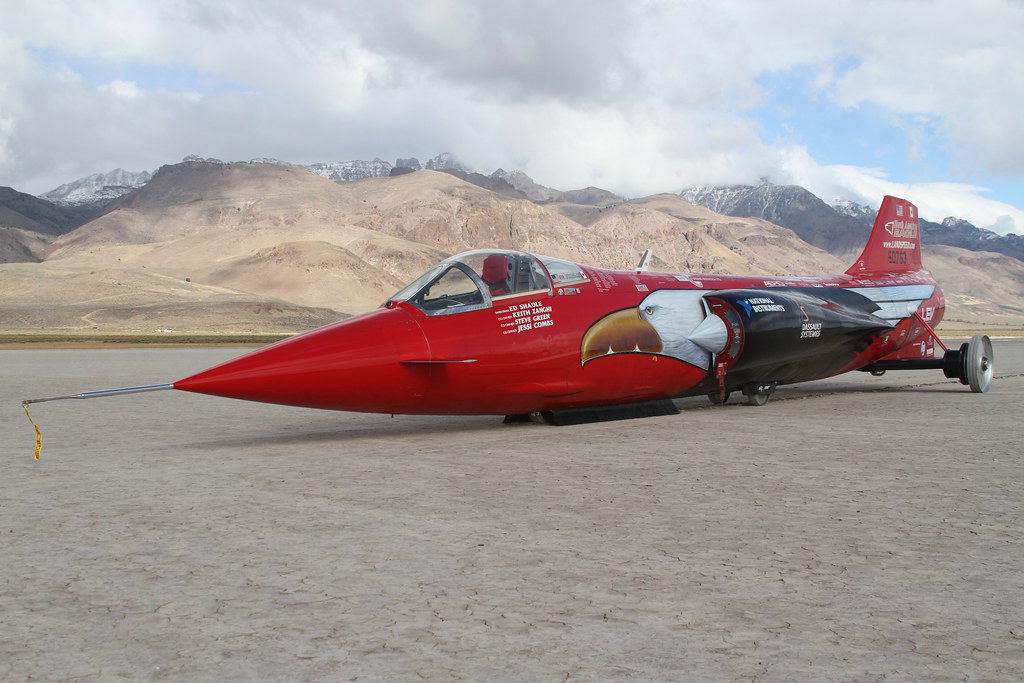
I recently got to travel once again to the beautiful Alvord Desert in southeast Oregon to join the North American Eagle team as they continued their assault on the world land speed record. One of the goals for this year's trip was for new co-driver Jessi Combs to attempt to break a pair of long-standing records, the 308 mph mark set at Bonneville in 1965 by Lee Breedlove, wife of then world record holder Craig Breedlove; and the 512 mph record set at Alvord in 1976 by Kitty O'Neal driving the rocket-powered "SMI Motivator."
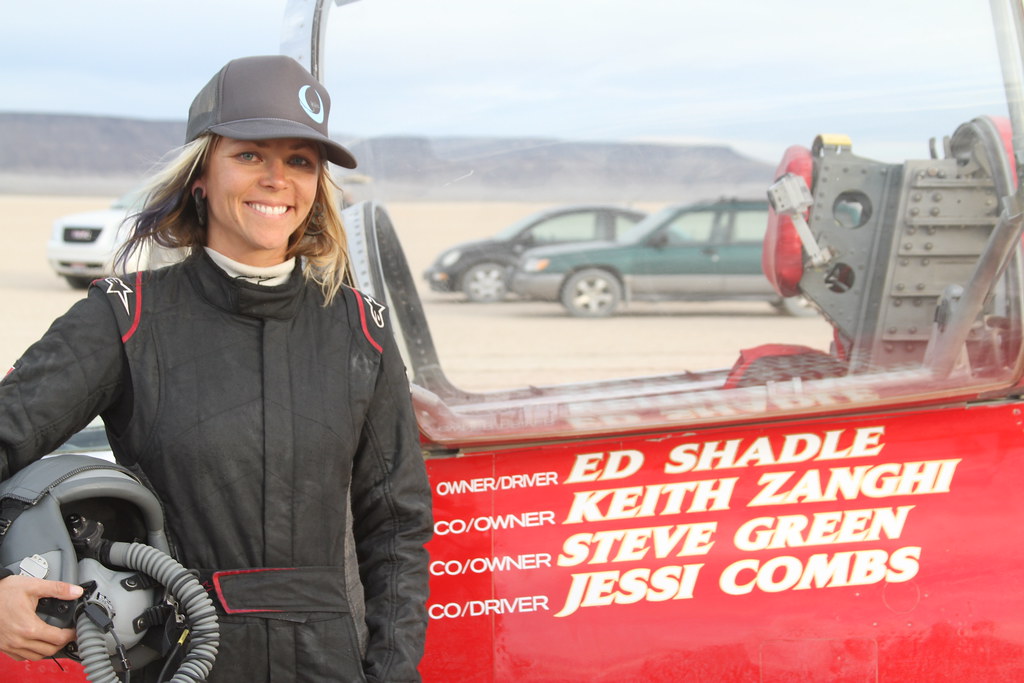
After just two test runs, on Tuesday, October 8, Jessi broke Breedlove's record, with a two-way average speed of 344.002 mph through the measured mile.
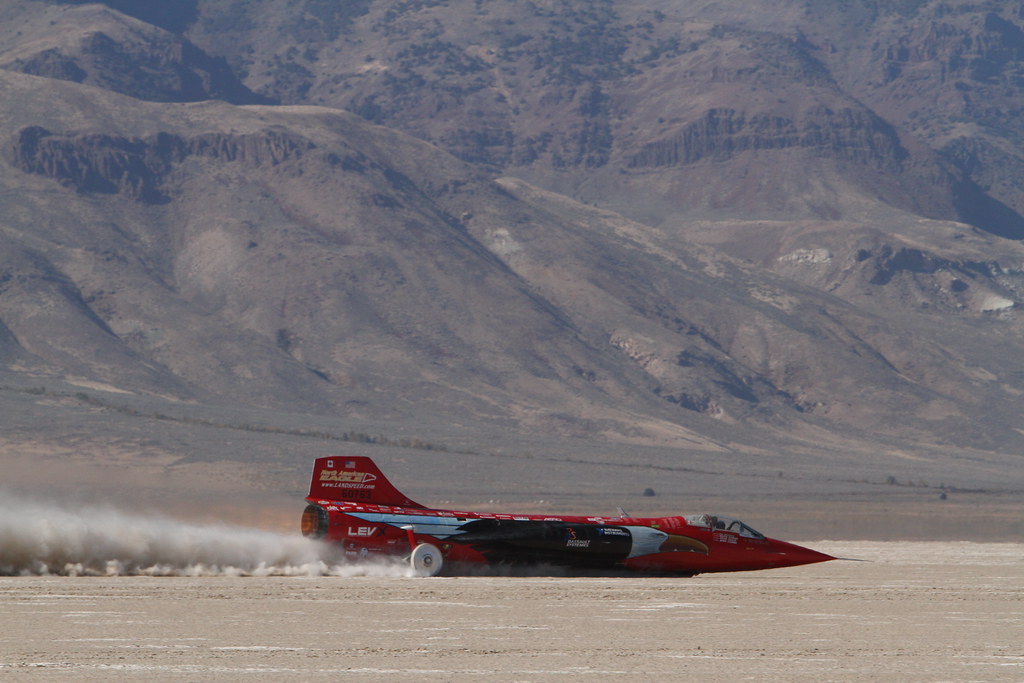
The next day, Jessi climbed back into the NAE vehicle and made two more runs. This time, she went to full afterburner on both runs. With her parents, sister, and "The List" co-host Patrick McIntyre watching, Jessi reached a top speed of 440.709 mph, pushing her two-way average to set a new record of 392.954 mph and making Jessi Combs the fastest woman on four-wheels.
I have created a video showcasing the second of her two October 9 runs, which I posted to YouTube on Friday.
There are also a lot more of my photos on Flickr.
For those curious about the two women's records, Lee Breedlove set her 308 mph mark in her husband's "Spirit of America Sonic 1" jet-powered car, driving on the salt flats at Bonneville. Since Sonic 1 had four wheels, it is considered a "car" and therefore comes under the rules set by the FIA. The vehicle that Kitty O'Neal drove in 1976 had just three wheels and is therefore considered a "motorcycle" and comes under rules set by the FIM.
Also, since it was powered by a hydrogen peroxide rocket engine, Motivator reached its top speed much faster than a jet-powered vehicle, enabling Kitty to go more than 512 mph on the relatively short Alvord Desert. The North American Eagle team hopes to either "coax" a few more usable miles of smooth desert out of the dry lake bed at Alvord or else find another location so that next year Jessi can beat O'Neal's record, making her undisputedly the world's fastest woman. And NAE owner and co-driver Ed Shadle hopes to break the current world land speed record of 763.1 mph, set in 1997 by Andy Green driving the "Thrust SSC."
Since I am at work on a book about the land speed record, I plan to be on-hand when this occurs.

Also, if you would like to learn more about the North American Eagle, Jessi Combs, and the beautiful Alvord Ranch (where the team was graciously hosted by Paul and Toni Davis) check out the following links:

Tuesday, September 10, 2013

HP Expands its Z Workstation Portfolio

While most people were waiting today for Apple to make official what most people already assumed was coming, I was patiently waiting to be able to write about some really cool new stuff that I learned about last week but couldn't write about until today.

Last week, I spent a day in the Big Apple at an HP press and analyst event at which the company unveiled a number of new workstations and display products, including the world's first workstation ultrabook, the HP ZBook 14.
The new HP ZBook 14

Unlike other ultrabook computers, the new HP ZBook 14 is a true mobile workstation complete with an AMD FirePro M4100 discrete graphics card with 1GB of dedicated GDDR5 memory. HP will be offering a choice of Intel Core i5 and Core i7 processors. One of the really cool features is that the system automatically switches from the integrated Intel HD Graphics 4400 to the more powerful AMD GPU when needed. Since it's an ultrabook, it comes with a 10-point multi-touch screen. But since it's also an HP workstation, it's ISV certified and comes with HP tools including HP Performance Advisor and HP Remote Graphics Software. It may just be the perfect portable for engineering professionals on the go.

The company also announced two other new mobile workstations, the HP ZBook 15 and ZBook 17. These mark the latest iteration of the company's mobile workstation line, with a name change to clearly identify them as members of the HP Z-workstation family (as opposed to the older EliteBook moniker). The new ZBook 15 will include an option for a super-high-resolution QDH+ 3200x1800 display. Both the 15 and 17 feature a Thunderbolt port as well as optional DreamColor Display panels.
The entire new HP ZBook mobile workstation family
The new ZBook mobile workstations feature 4th Generation Intel Haswell dual- and quad-core processors and next generation technologies from NVIDIA and AMD, including the newly announced Keplar-based professional graphics from NVIDIA. And all three ZBook mobile workstations feature innovative new tool-free chassis for easy upgrades and serviceability.

HP also unveiled updates to the Z420, Z620, and Z820 workstations to include the latest Intel Xeon E5-1600v2 and E5-2600v2 "Ivy Bridge" families of processors as well as memory running 16% faster and 2nd generation Thunderbolt ports for data transfer speeds 4 times faster than USB 3.0.

The new HP Z  workstation family and new Z27i and Z30i IPS displays
Lastly, HP added to its line of professional displays, announcing the new HP Z27i and Z30i displays, which incorporate IPS Gen 2 panels that deliver 100% of the Adobe RGB color space while offering power savings of up to 37% compared to HP's first generation IPS displays.

The HP ZBook 15 and 17 are already available, with the ZBook 14 scheduled to be released in October. The updated Z420, Z620, and Z820 workstations as well as the new displays will also become available in October. I hope to be able to review all of the new workstations and displays as soon as I can get my hands on them, so stay tuned.

Tuesday, April 16, 2013

File Tabs in AutoCAD 2014

One of the coolest new features in AutoCAD 2014 are the new File Tabs. Located across the drawing area (just below the ribbon), the new File Tabs provide a fast and visual way to switch between open drawings or to create new ones.


When you first start the program, you will see a file tab across the top of the drawing area. With just a single drawing open, you see just one file tab, which corresponds to that drawing. But as you open additional drawings, you will see additional file tabs, one for each open drawing.

File tabs are just one of the new features included in my new iBook, AutoCAD 2014 New Features and Enhancements – Revealed!, published by 4D Technologies/CADLearning. I've uploaded the entire lesson video on File Tabs to YouTube so that you can see for yourself how File Tabs can make it much easier to work in AutoCAD, particularly if you have multiple drawing files open.


If you have an iPad, you can actually download the entire iBook for FREE from the Apple iBookstore. That's right, 4D Technologies/CADLearning has decided to make my new iBook AutoCAD 2014 New Features and Enhancements – Revealed! free this year. So, grab your iPad, open up the iBooks app, and hop on over to the iBookstore. As of today, this is the only iBook available for AutoCAD 2014. So just search for "AutoCAD 2014".
 
Now that AutoCAD 2014 is shipping, I can finally update my blog with news, tips, and tricks about AutoCAD and some of the other new software from Autodesk (including the new Autodesk ReCap software). So check back.

Tuesday, June 19, 2012

Rendering in AutoCAD: Ralph Got It Wrong

Judging from Ralph Grabowski's response to an email I sent him yesterday, I don't think he has any intention of publishing my response to an article in this week's edition of his Upfront Ezine. So I'll share my response here.

I have a great deal of respect for Ralph. He is usually quite thorough and calls it as he sees it. But this week, he simply got it wrong.

In this week's lead article, Ralph claimed to have done a head-to-head comparison of AutoCAD's built-in rendering command with Autodesk's new cloud-based rendering service and concluded that the Autodesk 360 rendering was much slower than built-in local rendering. (You can read Ralph's article at http://www.upfrontezine.com/2012/upf-740.htm.)

After reading Ralph's article, I wrote the following email:

I really must take issue with the methodology you used in comparing AutoCAD's built-in rendering command with the new cloud-based rendering. A rendering that takes only 4 seconds on your local machine is hardly a valid test.

As you know, I have been testing computers and graphics cards and writing about AutoCAD about as long as you have. My reviews are regularly published in Desktop Engineering magazine, and I have taught numerous classes about rendering at Autodesk University. I also recently added more that 3 dozen lessons on rendering, both local and cloud-based, to the CADLearning series ofvideo-based tutorials for 4D Technologies' AutoCAD 2013 course.

As part of my reviews for Desktop Engineering, I perform a rendering test using a drawing I obtained from Heidi Hewett at Autodesk. Although the drawing itself is relatively simple, it includes numerous materials and multiple light sources, all of which result in much longer rendering times. On a relatively fast dual-core workstation, it is not unreasonable for the rendering to take up to 5 minutes, whereas on a system equipped with two 8-core CPUs with hyper threading enabled, the rendering might be completed in less than a minute. In addition to the number of materials and light sources, the resolution of the rendered image as well as the render quality will also impact the overall rendering time.

Again, this is for a relatively simple model. It would not be unreasonable for a highly detailed model with multiple light sources, all casting shadows, to take 30 minutes or more even on a very fast system with multiple CPUs. While I have not performed any benchmark tests yet comparing local rendering of such a model to Autodesk's online rendering service, I would expect the online service to be considerably faster.

While you do make some mention of the fact that it does take some time to initially transmit the model to the Autodesk 360 service (and you experienced some problems in doing so), it is also worth noting that the online service can render multiple scenes from the same model, whereas to do this on a local system, you would need to render each scene individually. Furthermore, when you render locally, you cannot do anything else in AutoCAD while the rendering is being computed, whereas when you use the online rendering service, you can go back to work in AutoCAD as soon as the online render request has been processed.

I also suspect that most people who use the Autodesk 360 service log in when they first start AutoCAD. They would therefore already be connected when they clicked the Render Online button and therefore would not experience the same delays as you. 

From the image you supplied, I can see that you rendered the model at a resolution of 640x480 using the Medium render preset, settings that are hardly representative of real-world situations. In my tests, I typically render at a resolution of 1280x1024 using the Presentation Quality preset. It's also apparent from the lack of shadows and materials, that you likely rendered using the default lighting mode and that the Oil Module drawing contained no materials.

I suggest that you come up with a more realistic test before you start publishing results that are purported to be representative of real-world results or typical user experiences.
And what was Ralph's reply to my email?

"I clearly laid out the specifications for the benchmarking so that readers could take it at face value. Thanks for your input!"

That's hardly a useful response and I think it does his readers a disservice.

Come on, Ralph. You got it wrong.

Tuesday, November 29, 2011

AU Opening Keynote

AU kicked off this morning with one of the best keynotes in recent memory. After an intro by Jeff Kowalski, in which he outline 5 disruptive trends, a series of Autodesk customers, starting with a young engineer that has helped build a new lunar lander, came to the stage and delivered truly moving presentations.

They were followed by Autodesk President and CEO Carl Bass, who continued the theme of disruptive technology and explained in broad strokes how Autodesk is taking advantage of those trends.
I shot video of most of the keynote and will be posting portions of it later this week. So stay tuned.

Now it's time for me to finish prepping for the first of my two presentations this afternoon.

Monday, November 28, 2011

Join me for Coverage of Autodesk University 2011

It's the week after Thanksgiving, which means that I'm back in Las Vegas attending the 18th Annual Autodesk University. Today is dedicated to special meetings, including a press and blogger briefing that is just getting started.

I'll be posting as much information as possible this week...basically whatever I can tell you about that isn't under non-disclosure. So stay tuned.

Saturday, August 21, 2010

Tech Day at Infineon Raceway

Today was an absolutely incredible day here at Infineon Raceway. The IZOD Indy Car Series organized a Technology Day for writers.

_MG_2941

After arriving at the track and shooting photos of the Indy Lites practice, we met at the Media Center and were assigned to one of the team's pits for the morning IndyCar practice. This meant that we were sort of captive in the pits rather than being out around the track taking photos, but we got a first hand look at what goes on as the teams work to make final preparations to their cars before the afternoon qualifying session.

_MG_2964

After the practice session, we had lunch in the Honda Hospitality tent, hosted by Erik Berkman, President of Honda Performance Development. I've got lots of notes from our lunch meeting, many of which will be included in my forthcoming article.

_MG_2977

Then we were driven up the hill to the Versus TV Compound, where Robby Green, VP and General Manager took us through the many tractor trailers that house the various television production facilities, including one trailer containing cameramen operating the numerous remote controlled cameras scattered around the racetrack, and the main control room where the director and producers control the on-air broadcast.

_MG_3001

Then we went back down to pit row where we were met by Bryan Herta, former IndyCar Series driver and owner of Bryan Herta Motorsports. We each received Motorola headsets so we could hear all of the race team communications and also ask questions.

_MG_3021

Then we met with Jack Arute, the primary on-air commentator for Versus' coverage of IndyCar racing.

IMG_1483

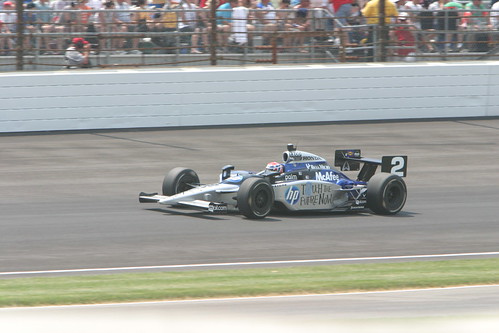
Next, we went to the pits of deFerran/Dragon Motorsports, where we met with Eric Zeto, the team's race engineer (who I also interviewed yesterday for my article) and Raphael Matos, driver of the #2 HP deFerran Dragon entry. They explained how the team collects and analyzes telemetry throughout the race.

IMG_1433

We then had a bit of a break, so I went back trackside to take photos of the Historic Grand Prix cars during their final practice session.

_MG_2958

To round out the day, we were driven up to the IZOD IndyCar Series Paddock Club, where we met with Gil deFerran, 2003 Indy 500 winner and owner of deFerran/Dragon Motorsports, and Tony Cotman, the project manager of the 2012 IndyCar. We also met with Matt Ellis, the manager of Infineon Raceway.

IMG_1510-1512-PANORAMA

It was an incredible day.


I've also got a bunch of videos that I shot throughout the day that I'll be uploading later once I can edit them down. So check back again later next week.

Friday, August 20, 2010

Racing in Sonoma

Friday was the first day of practice here at the Indy Grand Prix of Sonoma at Infineon Raceway. I climbed up the hill to watch the action in turns 2 and 3. Shooting late in the afternoon, this proved to be a dramatic location, with some excellent photo opportunities of cars as they crested the hill.
IMG_0888
Here's Marco Andretti, driving the number 26 car for Andretti Autosport. Marco already has a career win here at Infineon.
IMG_0969
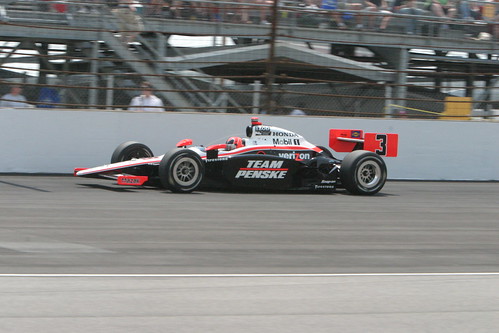
Will Power, driving the number 12 Verizon Team Penske car had some demons to vanquish. Coming over this hill during the race last year, he collided at full speed with the stationary car of Nelson Philippe, who had just spun. He broke two vertebrae in his back and missed the rest of the season. Power now leads the points total for the 2010 Indy Racing League season.
IMG_1054
Power had no problems negotiating the turn during practice, and would go on to clinch yet another pole position during Saturday's qualifying session.
IMG_1092
I'm here this weekend to work on an article on how de Farran Dragon Racing uses technology from its primary sponsor, HP, in the preparation and operation of its car, driven by IRL rookie driver Raphael Matos. I attended the Indy 500 this year as a guest of HP and will use the opportunity afforded by this weekend at Infineon to complete the research for my article.

Thursday, August 19, 2010

The Most Fun I've Had With My Clothes On

I've got to admit right off the bat that today, I felt like the proverbial kid in a candy store. I finally got to do something that I've wanted to do for a long time. I got to ride in an Indy Car 2-seater race car.

I watched other people doing this at several tracks, most recently when I was in Indianapolis for this year's Indy 500. At that time, I was ready to pay to ride, but then learned that all of the opportunities were already sold out for the entire weekend. Well, today, I finally got my chance.


Here I am all suited up and waiting for my turn.

I'm at Infineon Raceway in Sonoma, California to photograph the Indy Grand Prix of Sonoma, the last road course race of the 2010 Indy Racing League season.

Thanks to my friends at HP, today I got to partake of the "Indy Racing Experience." What's more, my driver today was Davey Hamilton, one of the drivers with Dragon Racing, the team sponsored by HP. I'm currently working on an article about the team.


The 2-seater is a larger version of an actual Indy car. It's got the same engine that they ran last year. The only difference is that it's longer, with a second seat behind the driver.

After arriving at Infineon Raceway at 9am, I signed several pages of release forms and then went into a changing room to don my firesuit and boots. Then, I waited until it was my turn to put on a balaclava, helmet, and gloves and climb aboard behind Davey. After the crew strapped me in and surrounded my head with a Hans device, they started the engine and we took off.

What a kick. Going from zero to more than 100mph in a few seconds and then braking through the corners and up the hill at Infineon (still Sears Point as far as I'm concerned) was an incredible rush.

If there was any downside, it was that the two laps were over way too quickly. I talked with Davey afterwards and told him next time I want to drive.

I shot some video while at the track and also got some onboard video shot from a car-mounted camera. I've edited the footage together and posted it on YouTube. Here it is. Enjoy.


All I can say is, if you've ever thought of doing a 2-seater ride, go for it. And thank you HP for making my ride happen.

Thursday, August 12, 2010

Did You Know That I Am "Renowned"?

For the past several months, I've been working on a productivity study comparing AutoCAD 2008 to AutoCAD 2011. The basic idea behind this study was to attempt to quantify the potential time saved - or productivity improvement - that a typical user could reasonably expect to achieve by upgrading from their current version of AutoCAD to the latest release.

In order to quantify this improvement, I devised a series of tests involving timing the repeated re-creation of a selection of drawings using both AutoCAD 2008 and AutoCAD 2011. The drawings I used were representative of those that would be produced by typical AutoCAD users.

By upgrading from AutoCAD 2008 to AutoCAD 2011, I reduced the time required to create these drawings by 31 percent, reducing the overall time from 13.5 hours to 9.25 hours. When I then switched from AutoCAD 2011 on an older workstation running Windows XP to a newer workstation running Windows 7, the time required was reduced further. On the more modern system, it took just 7.5 hours to create the same eight AutoCAD drawings, an overall reduction in time of 44 percent from AutoCAD 2008.


I thought that was pretty dramatic. So did Autodesk. And so did the folks at HP and NVIDIA, co-sponsors of the study.

The complete productivity study is now available on the Autodesk website.

I'll also be participating in a webcast next Tuesday, August 17, from 10:00-11:00am Pacific time. I hope you'll join us for the webcast, hosted by Heidi Hewett.

Monday, July 26, 2010

One of My Photos Wins Photo Contest

I was just notified that one of my photos from the Vancouver Winter Olympics has won first prize in the 5th Annual Quicksilver Photo Contest.


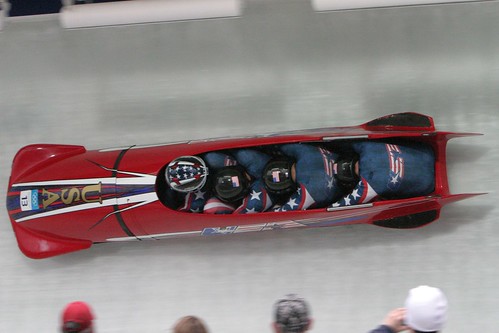
My photo of the USA 3 bobsled driven by Mike Kohn flying past spectators at the Whistler Sliding Center during the final heat of the 4-man bobsleigh competition at the 2010 Vancouver Winter Olympics was taken on February 27, 2010 using a Canon 10D and a Canon 70-200mm f/2.8L IS USM lens at 1/500 second, f/8, 70mm, and ISO-1600. The winning image is cropped just slightly from the original.

This photo, along with winners in other categories, will be on display at Quicksilver Photo Lab beginning on Friday, July 30, 2010.

Tuesday, June 1, 2010

The 94th Indy 500

With all of my travel this past week, it's taken me a few days to sort through all of my photos and post this report on the actual race. What an incredible experience.


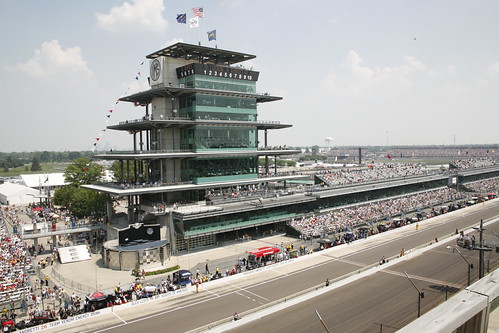
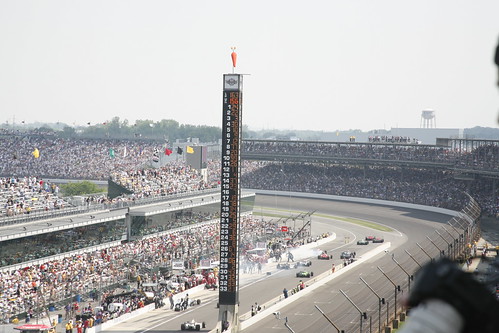
There's something magical about the Indianapolis Motor Speedway. The Indy 500 is truly the greatest spectacle in motor racing, and everything about this track, including the new Pagoda at the start/finish line, is iconic.


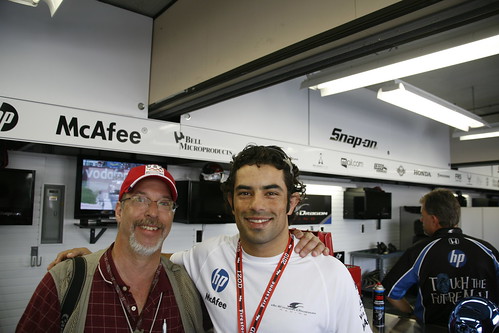
On Sunday morning, before the race, I got to hang out in the de Ferran Dragon Racing garage and spend some time talking with drivers Rafael Matos and Davey Hamilton and the rest of the team. What an incredibly gracious group of people.


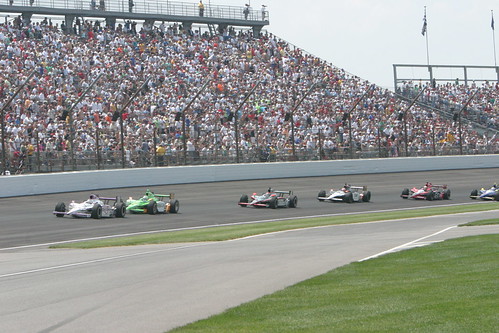
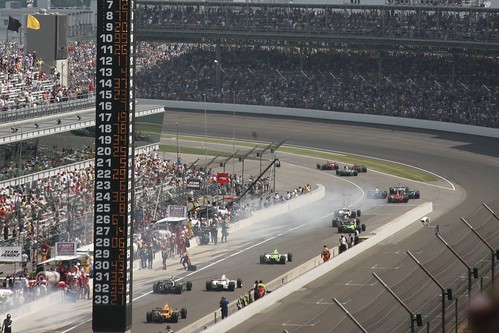
I watched the start of the race and the first round of pit stops from the Dragon Racing pits and then moved over into turn 1 to shoot some of the early race action. With a 500-mile race there would be plenty of time to move around to the different vantage points afforded by my press credentials.


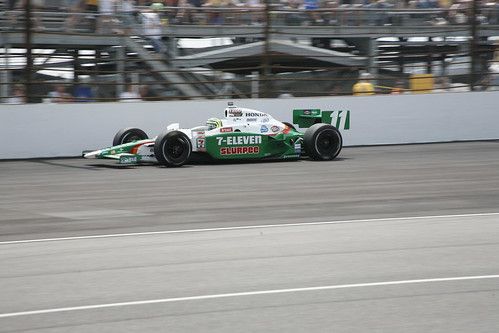
I think a lot of people were rooting for Tony Kanaan, who started in 33rd position, the very last car on the starting grid, but quickly moved up through the field, eventually getting as high as second place before he had to stop for fuel just 4 laps from the end, finishing in 11th place. What a performance.


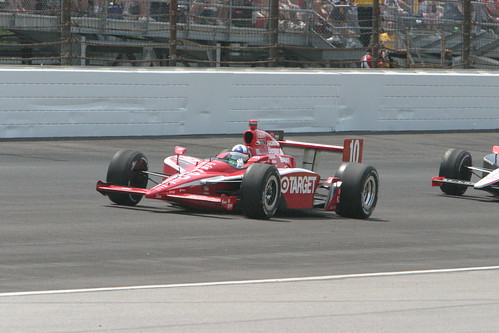
Dario Franchitti quickly put his Target Chip Ganassi car into the lead and led the race for more than 150 laps.


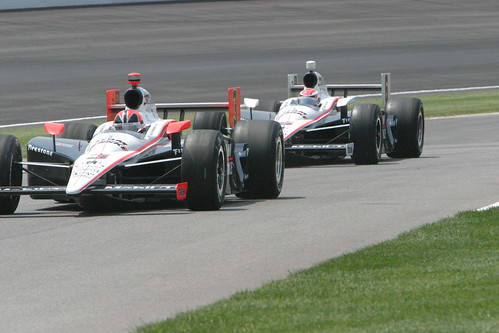
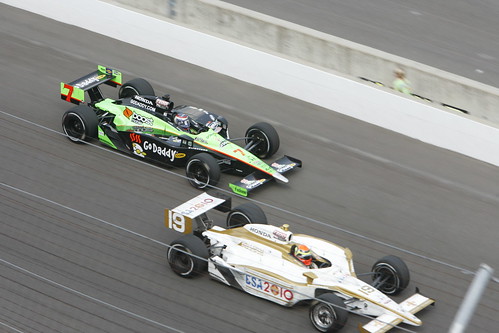
They say that you can't win the Indy 500 on the first lap, but you can lose it on the first lap. That was certainly true of Dragon Racing today. Davey Hamilton was forced into the wall leaving turn 2 on the very first lap to avoid a collision with Tomas Scheckter and was out of the race almost before it began. Pit stops also proved to be problematic for many cars, including the usually unshakable Penske team. Here pole sitter Helio Castroneves and second-row qualifier Ryan Briscoe leave the pits during an early pit stop.


Roger Penske seemingly couldn't believe some of the problems his team experienced in the pits, but theirs wouldn't be the only problems.


Standing behind the barrier in the short shoot between turns 1 and 2, I was very excited to watch as de Ferran Dragon Racing driver Rafael Matos moved up through the field from his 12th starting position to 3rd overall.


Dan Weldon in the number 4 National Guard car entered by Panther Racing was also doing very well, moving up from his 18th starting spot on the outside of row 6.


Pole sitter Helio Castroneves stayed up in the mix throughout the early action, a favorite to win his fourth Indy 500. He seemed quite happy to stay back a few positions and just run with the leaders.


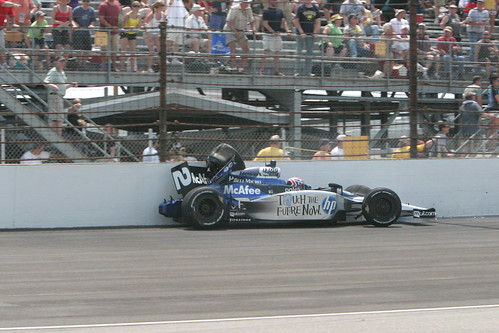
Things seemed to be playing out smoothly, and then came a series of mishaps. Rafael Matos pitted on lap 67. Both he and Scott Dixon had problems during their stops, with both cars losing wheels. For Matos, the long stop dropped him way back in the field. He returned to the pits three laps later for a wing adjustment. Once back on the track, he pushed a bit too hard. On lap 73, Matos spun coming through turn 1, slamming the rear end into the Safer Barrier amid a shower of sparks. His car came to a stop in turn two, his day over.


With both of the de Ferran Dragon Racing cars out of the race, I was ready to move to a new photo location. I shot for a while in the now empty Dragon Racing pits, but decided to move higher to watch the final stages of the race. On a tip from a fellow photographer, I made my way up onto the roof of the grand stand just about the start/finish line. From there I could see most of the track and had a great view of all the action on the main straight.


My roof-top vantage point proved to be an excellent position, as I was able to watch the drama continue to unfold on pit lane. While the leaders battled, Danica Patrick continued to move up through the field. She would eventually finish 5th.


But things would continue to be nuts in the pits, with several more cars touching wheels late in the race.


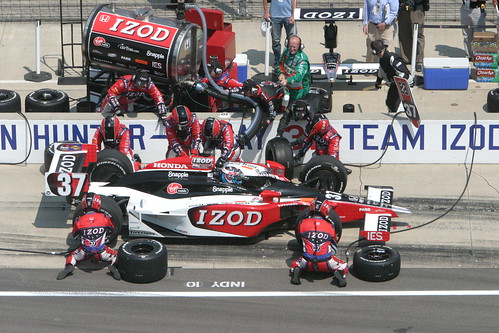
At other tracks I've been able to actually shoot pits stops from the pit wall at ground level. With cars flying by at more than 230mph on the front straight at Indy, however, I was quite happy shooting down from my higher vantage point.


Here Ryan Hunter-Raey's number 37 Izod car gets serviced during the final round of pit stops on lap 163. He would eventually finish in 18th position.


Being directly above the start/finish line had other advantages, as I had a perfect view as Dario Franchitti and Dan Weldon took the checkered flag at the end of the race.


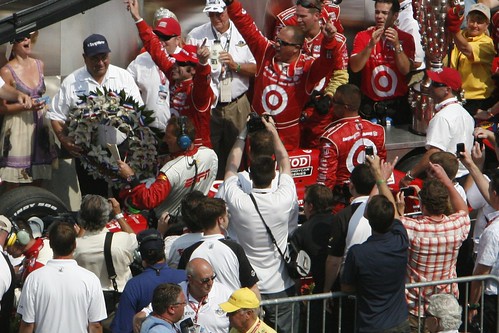
And once race winner Dario Franchitti brought his number 10 Target Chip Ganassi Racing car to a stop in pit lane, I had a birds-eye view as his team rushed to congratulate him.


Here's Dario as he celebrates his victory, with his wife Ashley Judd looking on.


And yet another photo of Ashley Judd and Dario Franchitti in victory circle.


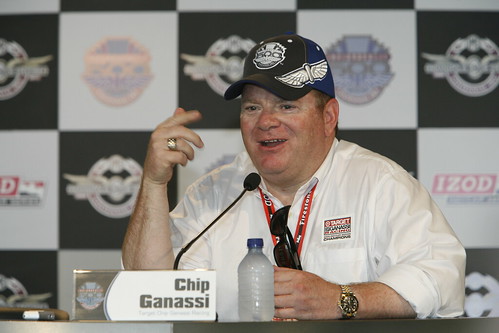
With temperatures reaching 98 degrees, making the 2010 Indy 500 the hottest on record, I was quite happy to sit in the air conditioned press center for the post-race press conference. Here, Chip Ganassi describes what it's like to win both the Dayton 500 and the Indy 500 in the same year. "I didn't drive the car. I didn't put fuel in it. I didn't change any tires," said Ganassi. "I'm just a lucky guy to be in this business."


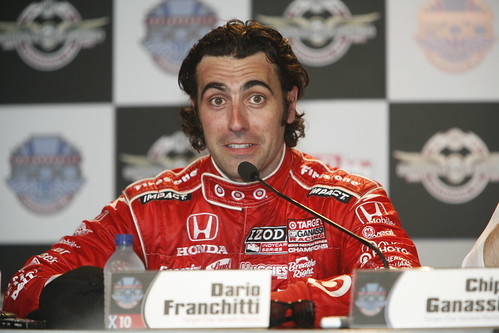
And then it was Dario Franchitti's turn to answer questions. When asked whether winning the Indy 500 twice finally put him in the same league as his heroes Jackie Stewart and Jim Clark, he replied that "I could could win the Indy 500 for the rest of my life, until I'm 70, and I still wouldn't be in the same league as Jim Clark and Jackie Stewart."


Dario's wife, actress Ashley Judd, looked on during the post-race press conference, at one time cracking up with laughter when, in response to a question, Dario said that having to now choose which of his two Indy wins was his favorite would be like having to choose which of his two dogs he liked best.


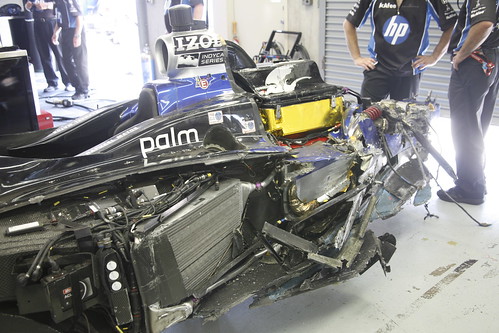
Ever wonder what a car looks like after hitting the wall at nearly 200mph. I wandered back to the de Ferran Dragon Racing garage after the race for a look at the remains of the number 2 car of Rafael Matos...pretty ugly. Now it remains to be seen whether the team can make repairs in time for next week's race at the Texas Motor Speedway.

Of course, it was tough selecting just these photos to share with you. If you'd like to see more, you'll find more race-day photos on my Flickr site.